
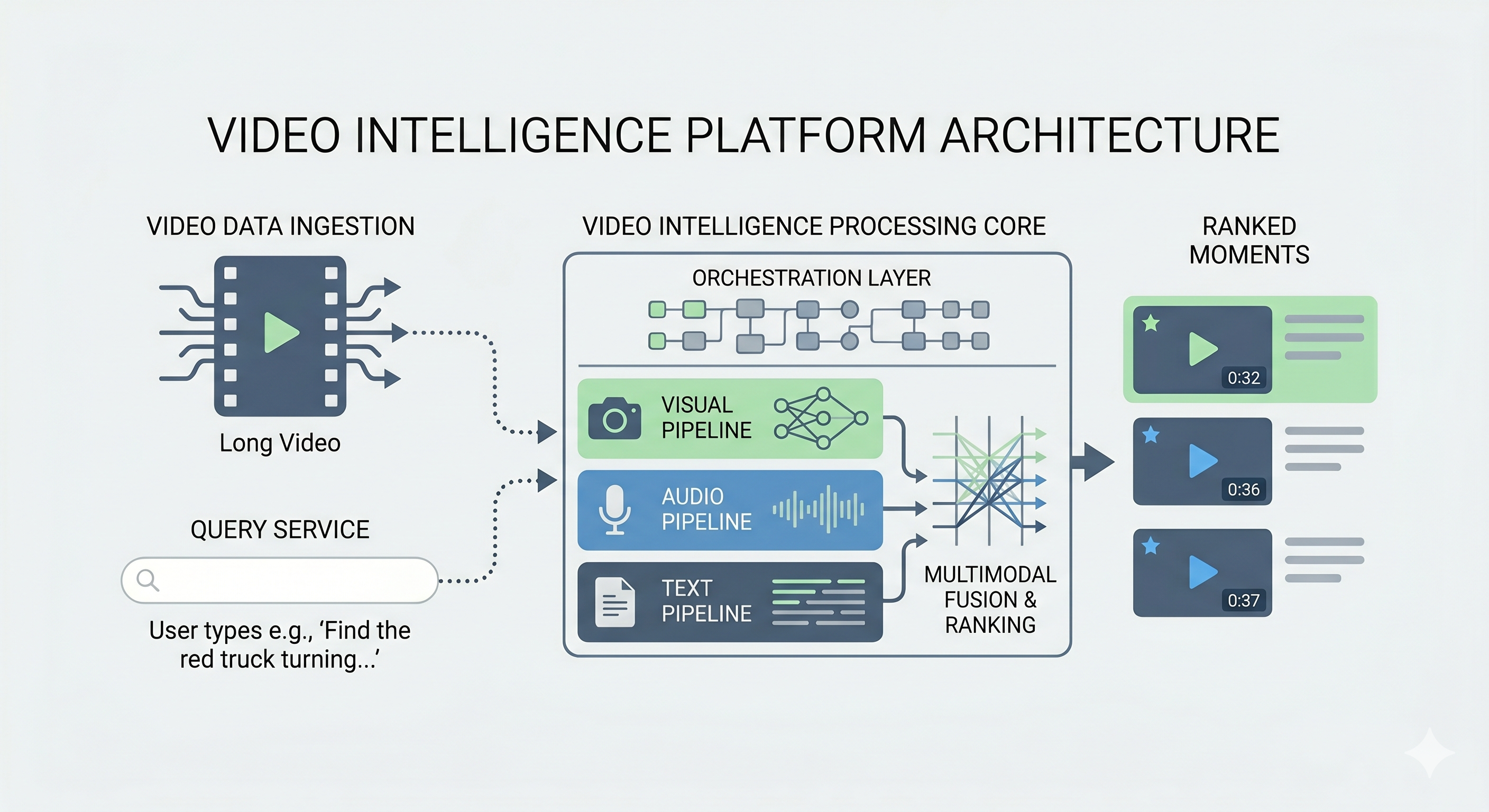
Most organizations already have video.
They have training recordings, product demos, internal meetings, webinars, lectures, film archives, sports footage, broadcast feeds, surveillance clips, field recordings, customer calls, and years of institutional knowledge captured in long-form media.
What they often do not have is video intelligence.
The difference is important.
A storage system can tell you where a video file is. A video intelligence platform should tell you what happened inside it, where the relevant moment occurs, what evidence supports the result, and how that moment can be reused safely in another workflow.
That is the problem LuminaCore AI is built to solve.
LuminaCore AI turns long-form video into searchable, source-linked, reviewable intelligence. It is not a traditional video storage layer. It is not a basic transcript search tool. It is not a one-off summarization product. It is a video intelligence platform designed to help users retrieve, understand, review, and activate the exact moments that matter inside large video libraries.
At the heart of this platform is DHRUV — Deep Heuristic Retrieval for Unified Vision.
DHRUV is LuminaCore AI's proprietary intelligence core. It transforms raw video into structured, searchable intelligence by understanding speech, visuals, on-screen text, entities, time, and context as connected evidence. DHRUV does not treat video as a flat file. It treats video as a timeline of meaningful moments that can be searched, reviewed, clipped, summarized, and reused.
This article explains the architecture philosophy behind LuminaCore AI. It does not disclose internal algorithms, implementation details, ranking logic, model choices, infrastructure design, customer-specific workflows, or proprietary processing methods.
The goal is simple: explain why searchable video requires a new architecture, without exposing the private blueprint behind LuminaCore AI.
1. Video is the largest unstructured knowledge layer
Text became searchable decades ago. Emails became searchable. Documents became searchable. Databases became queryable. Knowledge bases became retrievable. Most enterprise software assumes that important knowledge can eventually be indexed, searched, referenced, and reused.
Video has not followed the same path.
A two-hour video can contain more operational knowledge than a long document, but most systems still treat it as a passive file. A user can search the title, upload date, folder name, owner, or manually entered tags. In some systems, they may be able to search a transcript. But the actual meaning inside the video remains difficult to retrieve.
This is why video libraries often become graveyards.
A company records product demos but cannot find the exact feature explanation later. A media archive stores thousands of hours of footage but editors still scrub manually. A training academy records expert instruction but learners cannot jump to the exact procedure. A leadership team stores recorded meetings but cannot quickly retrieve decisions, commitments, or context. A security team records incidents but still reviews footage linearly.
The problem is not lack of recording.
The problem is lack of structure.
Video is rich, but it is locked. LuminaCore AI is built to unlock it.
2. Why video search is not document search
Document search is mostly spatial. A word appears on a page. A paragraph appears in a section. A heading gives context. The document has a title, body, and structure.
Video search is temporal and multimodal.
A useful answer may be spread across spoken words, visible objects, on-screen text, slide content, scene transitions, people, locations, gestures, movement, camera context, background audio, and metadata around the recording.
A user rarely wants the entire file. They want the exact moment.
A training user may ask, "Show me where the instructor explains vehicle inspection."
A media editor may ask, "Find the scene where the actor enters the courtroom."
A marketing team may ask, "Show every moment where this product appears."
A reviewer may ask, "Find the timestamp where the incident begins."
A leadership team may ask, "Generate a brief from the relevant recordings."
A file-level result does not solve this problem. If the system returns a ninety-minute video, the user still has to open it, scrub through it, listen, skip, rewind, and manually locate the useful section.
That is not intelligence. That is a better folder.
A video intelligence platform must retrieve the source-linked moment.
3. The core idea: index moments, not files
The central architectural idea behind LuminaCore AI is simple:
The searchable unit of video should be the moment, not the file.
A file is the container. A moment is the unit of intelligence.
A moment is a bounded section of video where something meaningful happens. It may contain speech, visual evidence, on-screen text, entities, topics, source metadata, and a timestamp range. The moment is useful because it can be searched, reviewed, replayed, clipped, summarized, cited, exported, and connected back to the original source.
This changes the user experience.
Instead of asking users to search a folder and then manually inspect long recordings, LuminaCore AI helps them search inside the video library and retrieve the exact section that matters.
The user does not just get a file.
The user gets a source-linked moment.
That shift is the foundation of the platform.
4. DHRUV: Deep Heuristic Retrieval for Unified Vision
DHRUV stands for Deep Heuristic Retrieval for Unified Vision.
DHRUV is LuminaCore AI's proprietary intelligence core. It exists because video understanding cannot be reduced to a single text extraction step. A useful system must understand video across multiple dimensions: what is spoken, what is visible, what text appears on screen, which entities matter, how events unfold over time, what the user is likely searching for, and how the result can remain traceable to the original source.
DHRUV performs five public-facing functions:
- It understands meaningful signals inside long-form video.
- It aligns those signals to time.
- It converts them into source-linked moment intelligence.
- It retrieves relevant moments based on user intent.
- It passes those moments into product workflows.
The internal methods behind DHRUV are proprietary. What matters publicly is the outcome: DHRUV turns raw video into searchable, reviewable, reusable intelligence.
DHRUV is not a utility pipeline. It is the intelligence core of LuminaCore AI.
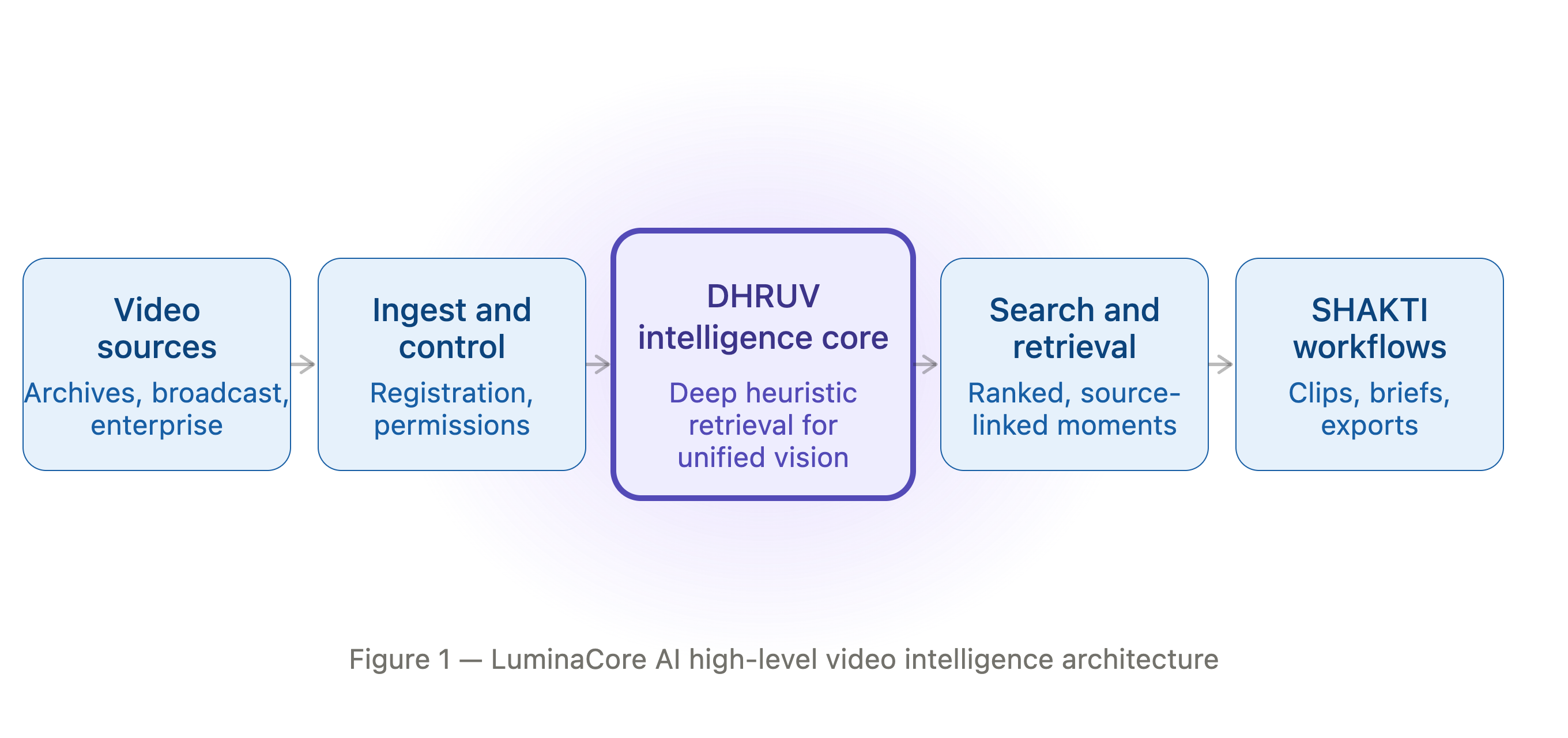
5. SHAKTI: the LuminaCore AI platform layer
DHRUV is the intelligence core.
SHAKTI is the LuminaCore AI video intelligence platform.
SHAKTI brings DHRUV's intelligence into real user workflows: Library Search, Clip Studio, Briefs, summaries, subtitles, review flows, evidence packs, and structured exports.
This distinction matters.
DHRUV understands the video. SHAKTI operationalizes that understanding.
In a standard enterprise or media environment, SHAKTI can power searchable video libraries, content reuse, campaign clip workflows, training archives, internal knowledge search, executive summaries, and multilingual outputs.
In private, on-premise, or controlled environments, SHAKTI can support stricter deployment requirements such as role-based access, audit logs, human review, controlled export, and local operational workflows.
SHAKTI is therefore not limited to one sector or one deployment model. It is LuminaCore AI's platform layer for turning video intelligence into usable workflows.
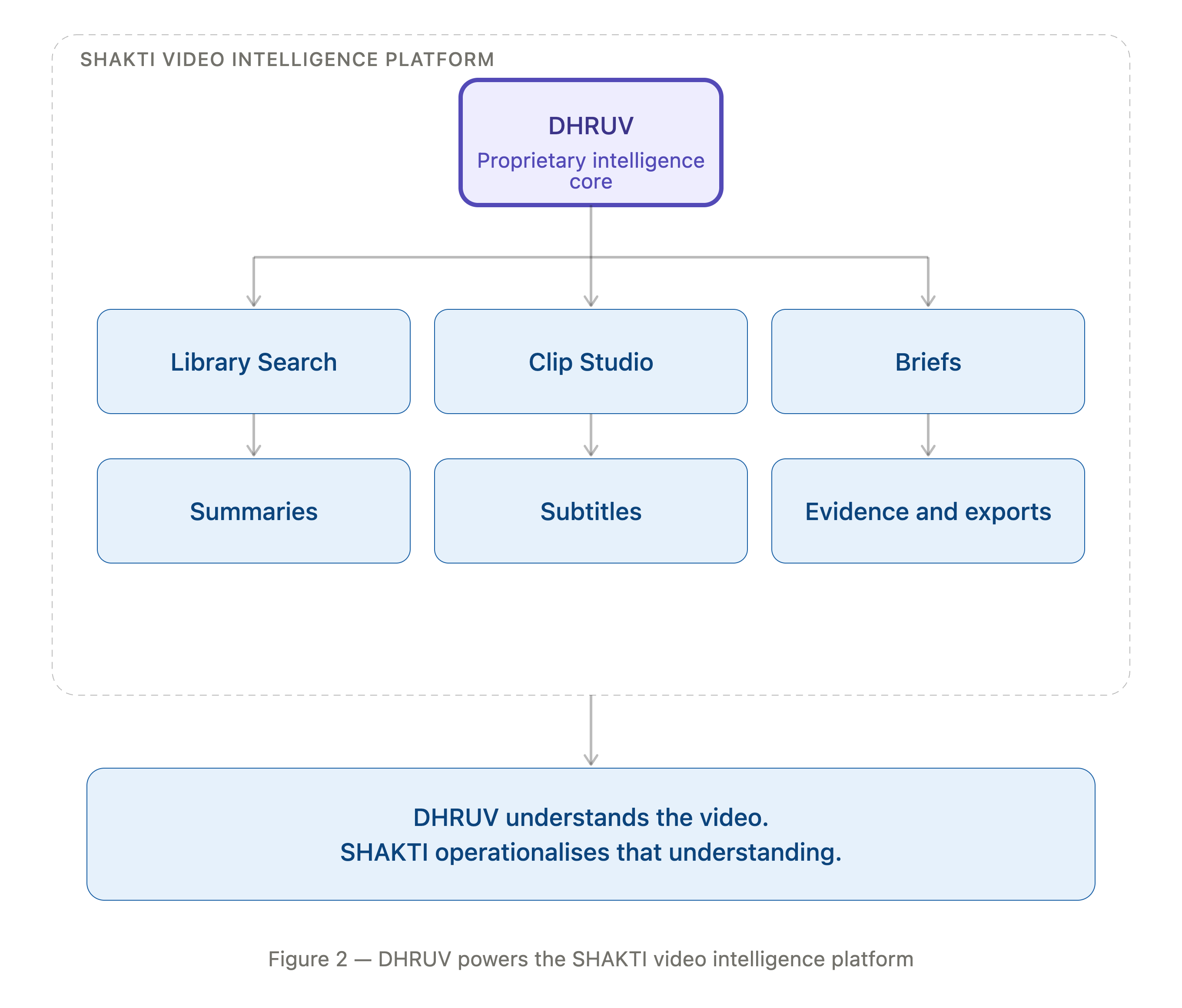
6. High-level architecture: from raw video to useful output
At a public level, LuminaCore AI can be understood through five layers.
The first layer is the source layer. This is where raw video enters the platform: media archives, training recordings, meetings, broadcasts, surveillance footage, creator content, or enterprise video.
The second layer is the ingest and control layer. This layer captures source context, ownership, permissions, metadata, and workflow intent. It ensures that the system understands what has entered the platform and how it should be handled.
The third layer is DHRUV, the proprietary intelligence core. This is where raw video becomes searchable moment intelligence.
The fourth layer is the search and retrieval layer. This is where users ask natural-language questions and receive ranked, source-linked moments.
The fifth layer is the activation layer. This is where retrieved moments become useful outputs: clips, briefs, subtitles, review packs, summaries, structured exports, and downstream workflows.
7. Why searchable video needs multiple signals
A video can be relevant for many reasons.
A phrase may be spoken.
A name may appear on a slide.
A product may be visible.
A person may be present but not mentioned.
An event may happen visually.
A location may appear inside a map overlay.
A topic may be implied but never stated directly.
If a system depends only on transcripts, it misses too much. If it depends only on manual tags, it cannot scale. If it ignores visual context, it cannot retrieve moments that users naturally expect to find. If it ignores entities, it loses the structure that makes large archives navigable.
LuminaCore AI therefore treats video as a multi-signal object.
The platform considers what is said, what is shown, what appears as text, which entities matter, and when each signal occurs. The result is a richer searchable layer than filename search, manual tagging, or transcript-only retrieval can provide.
The key public point is simple:
Video intelligence must search what was said, what was shown, and what was meant.
8. Why source links matter
AI-generated outputs are only useful when users can verify them.
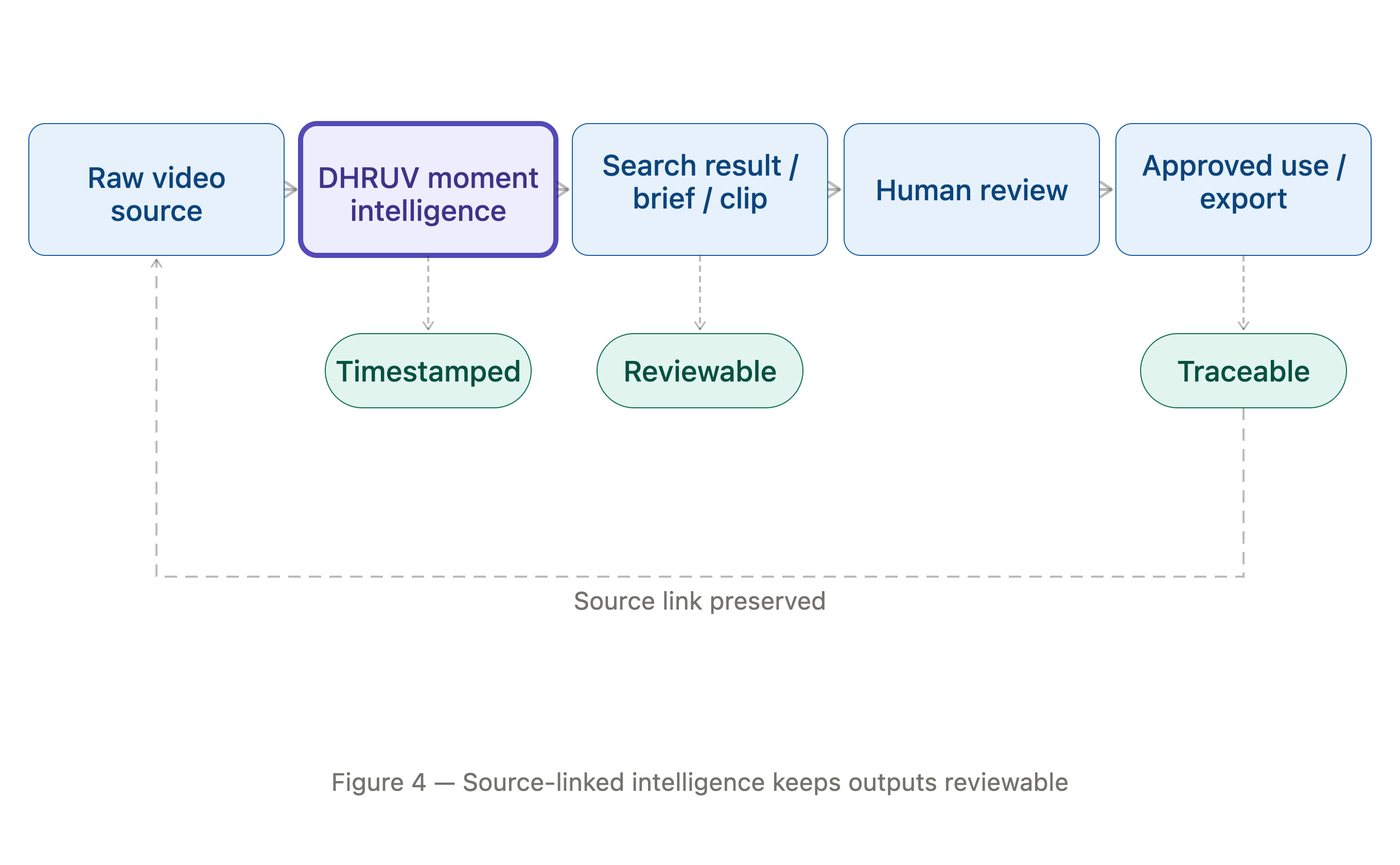
A search result should not simply say, "This is relevant." It should take the user back to the source video and timestamp. A summary should not exist as unsupported text. It should connect back to the moments that produced it. A clip should not lose lineage. It should remain traceable to the original recording.
This is especially important in serious workflows.
A media team needs to know which source asset produced a clip.
A training team needs to verify the approved instructional moment.
A business team needs to cite the meeting where a decision was made.
A public-sector or controlled environment needs review, audit, and accountability.
LuminaCore AI is designed around source-linked intelligence because trust depends on traceability.
The platform does not ask users to trust black-box outputs. It helps users verify faster.
9. Search is only the beginning
Search is valuable, but it is not the final outcome.
Once a user finds the right moment, they usually want to do something with it.
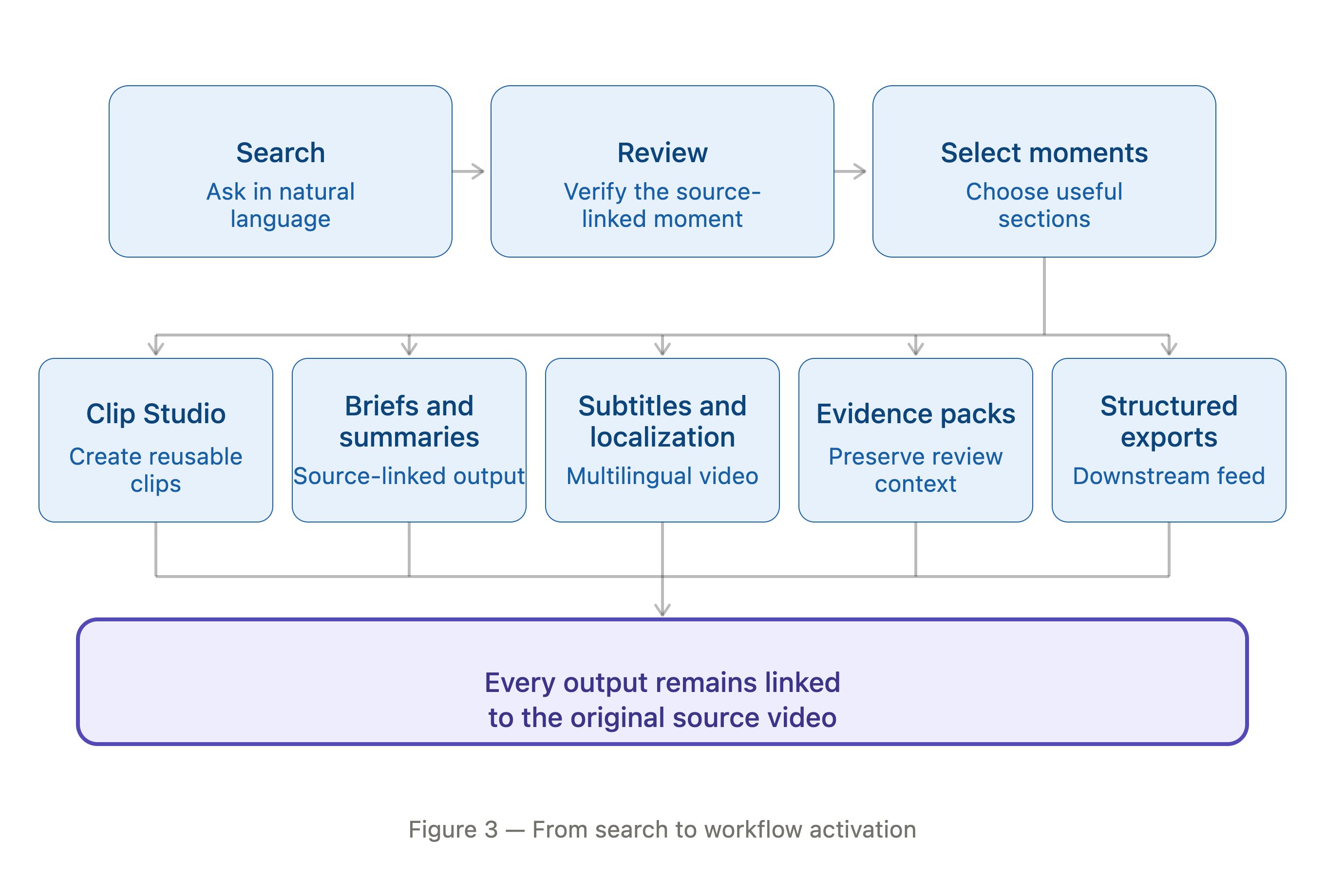
They may want to play it, save it, clip it, add it to a sequence, generate a brief, export a summary, prepare an evidence pack, create subtitles, share a reviewed segment, or send structured output into another workflow.
This is why LuminaCore AI connects retrieval to activation.
A retrieved moment can become a clip in Clip Studio. It can become a citation inside a brief. It can become a subtitle segment. It can become part of a review pack. It can become a structured record for downstream systems.
This is the difference between video search and video intelligence.
Video search helps users find something.
Video intelligence helps users use it.
10. Why long-form video requires stateful orchestration
Video intelligence workflows are not instant.
A long recording may need to be uploaded, prepared, understood, indexed, searched, reviewed, clipped, summarized, and exported. Some outputs may become available before others. Users may refresh the page. Jobs may take time. Some workflows may require review before export.
This means video intelligence cannot be treated like a simple request-response web feature.
LuminaCore AI is built around stateful orchestration. The platform needs to know where a video is in its lifecycle, which outputs are available, which actions are allowed, and what still needs to happen.
The user should not see vague progress. They should see meaningful state.
For example:
- source received,
- understanding in progress,
- initial intelligence available,
- search ready,
- review required,
- export ready,
- completed.
The exact internal states are implementation details. The public principle is that long-running video intelligence must be observable, recoverable, and understandable to users.
11. Governance is part of the architecture
Searchable video creates power.
Users can find sensitive moments faster. They can export clips. They can generate summaries. They can reuse archive material. They can search across large collections that were previously difficult to inspect.
That means governance cannot be an afterthought.
A serious video intelligence platform needs access control, review status, export permissions, audit trails, source traceability, and workspace-level policy. A moment may be searchable by one user but not exportable by another. A clip may be created but require review before sharing. A brief may be generated but remain in draft until approved.
LuminaCore AI is designed around human review and controlled activation.
The goal is not automation without oversight. The goal is speed with traceability.
12. Why this architecture matters now
Organizations are producing more video than ever, but most video still behaves like cold storage. It is captured, stored, and forgotten until someone manually searches for it.
That model does not scale.
Training teams need reusable instructional knowledge. Media companies need searchable archives. Enterprises need meeting and demo intelligence. Security teams need faster review. Public-sector and controlled environments need traceable evidence workflows. AI systems need structured inputs rather than raw video files.
The next generation of video platforms will not simply store media. They will turn video into searchable operational memory.
That is where LuminaCore AI is focused.
The platform gives video the properties that modern knowledge systems expect:
- searchable,
- timestamped,
- source-linked,
- reviewable,
- reusable,
- governable,
- exportable,
- and workflow-ready.
13. Conclusion: from passive video to searchable operational memory
Video is one of the richest knowledge sources in the world, but richness does not equal usability.
A video file sitting in storage is passive. A transcript is partial. A summary is not enough. Manual tagging cannot keep up. Linear review does not survive archive growth.
The future of video is searchable operational memory.
LuminaCore AI is built for that future.
DHRUV — Deep Heuristic Retrieval for Unified Vision — transforms long-form video into source-linked moment intelligence. SHAKTI turns that intelligence into workflows for search, review, clipping, briefing, subtitling, evidence preparation, and structured export.
The platform goal is simple:
Make video searchable.
Make results source-linked.
Make outputs reviewable.
Make archives operational.
That is the architecture behind LuminaCore AI.